
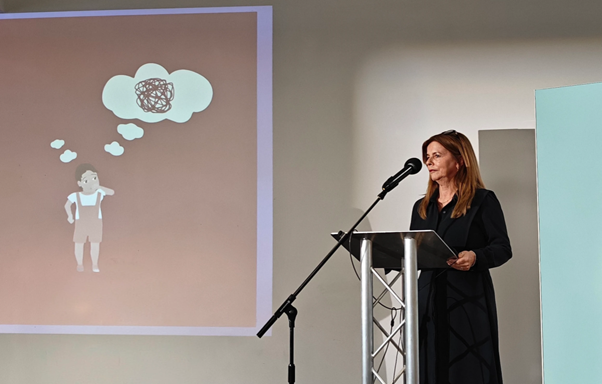
Earlier this month, we attended the Amity CIC conference in Sheffield, exploring how conflict between parents affects children’s mental health, development and life chances.
There, Jenny delivered her speech, discussing how we can move towards child-centred decision making. See the full speech below:
“I have been a family law solicitor specialising in domestic abuse (DA) and complex cases concerning children for over 30 years. I run a specialist practice which is a little different as we combine representing clients, alongside campaigning for systemic change to make our system work better for the children and families who pass through it.
In addition, I sit as the private law rep on the Family Justice Council (FJC) which is a multidisciplinary council chaired by the President and charged with monitoring our system. This gives me a ‘birds eye view’ of our Family Justice System (FJS) from the differing perspective of all its stakeholders. I also chair the Nuffield Family Justice Observatory (NFJO). This unique but critical organisation uses research-based evidence to identify challenges within the system and excels at reimagining solutions.
These differing roles have given me a real insight into the system and its operation. I want to share with you some observations about the way our FJS understands and responds to complex issues and where I see our critical failure to properly identify and manage domestic abuse and its impact on families and children. I also want to start a conversation about how a reimagined system, built to accommodate users lived experience needs to start with a shared vision. My opinions will be my own.
Over the last 30 years I have seen considerable change, but what worries me is not that which has changed, but that which has not. Domestic abuse is a crime and a killer, successive governments have pledged to address it, reduce it or even eliminate it yet the statistics remind us that these promises have failed. Two women per week are still killed by a violent partner or Ex partner.
Prevalence data underestimates the problem and masks its gendered nature. We see daily reports of horrific acts of abuse in the domestic sphere still minimised and normalised. We have poor data and only in 2021 did we have a statutory definition of DA which captured the highly dangerous coercive and controlling behaviours (CCB) and economic abuse (EA) behaviours which research shows us keep victims trapped and result in children growing up in dangerous and abusive environments.
The Domestic Abuse Commissioner’s (DAC) 2025 report, everyday business, reveals DA to be present in nearly 90% of private family law cases concerning children, yet our current system fails to respond safely to it, regularly minimising allegations and often retraumatising survivors.
I’d like to advocate a renewed effort to drive change by breaking down silos, promoting a more holistic way of working together to gather a better understanding of the lived experience of system users. A ‘shared vision’ if you will of a system which better hears and protects those it serves and has priorities we can all get behind a reimagined system which:
- helps children and families to thrive
- enables children and families to participate in vital decisions about their lives
- treats people fairly and with equity
Sadly, we have much to do. The first thing we need to accept is that our FJS is not in fact a system at all, it is a series of silos operating with different drivers, a lack of shared vision or even a common language. This fragmentation undermines effective collaboration and results in a ‘system’ which fails complex and intersectional issues
Moreover, it is a ‘system’ itself in trauma. Underinvestment, work overload, chaos and burnout have become the norm for practitioners across all the silos making up our system. It’s a fragile system and fragile systems are rarely equipped to deal with complexity.
The resulting chaos disproportionately impacts survivors of abuse and children growing up in households characterised by high conflict and abuse.
Indeed, to adopt the foundational ethical principle from the NHS ‘do no harm’ I would venture to argue that the current operation of the ‘system’ itself is actually capable of compounding harm. These failures cannot be ignored.
We need to stand back from our system, and our individual silos to identify challenges and collectively champion better practice
In my short talk I’d like to address the main barriers to justice and start a conversation about a system which properly addresses them. A system which flips its lens to properly capture lived experience, to hear the voices of the children and families who use the system rather than focussing on the operational players within the system.
So, what do the challenges look like? Well, I will try to focus on just a few.
- Unequal access to justice
- An adversarial approach which polarises parents and silences survivors and children
- Lack of transparency, consistency and accountability
- Ineffective mechanisms to hear children’s voices
Against these challenges survivors of DA and their children experience even greater difficulties. They are more likely to be experiencing trauma and need additional protection to ensure their rights are upheld. Yet these challenges disproportionately impact them. Let’s explore them in a little more detail to illustrate the point.
Unequal access to justice:
Unequal access to justice disproportionally impacts survivors of DA and their children. It has resulted from years of underfunding and lack of prioritisation of basic legal advice
The destruction of any functional legal aid scheme has resulted in 80% of parents now enter proceedings without legal representation, often navigating complex processes at times of significant emotional stress without support.
Moreover, prohibitive bureaucracy (including gateway and unnecessary means test) means many survivors of DA are often denied representation. But this isn’t the only problem
Derisory rates of pay have resulted in practitioners being forced to leave legally aided work. This means that survivors who are eligible for LA find it increasingly difficult to find a solicitor to take their case on. Many report calling dozens of lawyers before finding anyone with capacity to help.
Those with complex needs / who have language barriers or additional communication needs find getting help even harder under LA as their cases will potentially require more time against the backdrop of a fixed fee regime.
Representation at court is the next hurdle. With private cases commanding fees 10 x greater it is often difficult to secure much more than a very junior barrister at court for LA clients. Yet these are complex cases. Evidencing abuse, its impact on children and the associated danger against a pro contact culture takes expertise and experience.
An uneven playing field emerges. DA is a gendered crime disproportionately impacting women. Gender pay differences mean that men are more often able to afford expensive and experienced barristers leading to inequality of arms which undermines justice.
Where alleged perpetrators cannot afford representation, the situation is no better. Even where they have no means they will not satisfy the test for legal aid unless they can prove they are a victim. This is also unjust. Moreover, it encourages a new route for post separation abuse via the actual court process itself – the process which is supposed to be keeping survivors and their families safe.
This brings us back to ‘do no harm’. It is commonplace to find unrepresented parties forced into a polarised situation from the outset. Many use the actual process itself to abuse and, the system lets them. The removal of LA for alleged perpetrators now means survivors often now face their abuser without the ‘buffer’ of a lawyer.
In a desperate effort to maintain fairness between represented and unrepresented parties, Judges accommodate late filing, breaches of the rules, excessive paperwork. All of which can be manipulated to undermine a traumatised survivor from achieving best evidence.
In short, the impact of cuts to legal aid and the lack of commitment to a workable system has dealt survivors and their children a real blow. It has made an already fragile system even more unfair and dangerous.
The adversarial model:
The second challenge I want to raise is our reliance on an adversarial approach. Our entire court system is built on an adversarial model which
- polarises parents
- silences survivors of abuse.
- fails to effectively problem solve
- It is not trauma informed, indeed it often re traumatises survivors as a result.
Again, survivor victims are clearly the most impacted because the system hobbles their opportunity to achieve best evidence. Why is this? DA survivors are usually in trauma, yet our processes are not trauma informed. We expect evidence to be clear and corroborated. We expect witnesses to forensically dive into their memory to confirm dates, times, facts and feelings which support what they say. Yet we know that the impact of trauma on the brain is to shut down the part which acts as the filing cabinet of facts, dates etc. The exact part survivors need to access to prove what has happened to them
We know the courts need to be trauma informed to be fair, yet they aren’t. In order for DA to be considered relevant in proceedings concerning children it must be proven as a fact. The onus is on the person alleging the abuse, so the stakes are high. Yet as we’ve just identified, our underfunded, adversarial system mitigates against the sort of time and support needed to explore, evidence and recognise the impact of abuse on children and families.
Moreover, a failure to ‘prove’ abuse means, in the eyes of the court process, the abuse has not happened. Our binary system says that absent a finding, which may have failed to be found for a number of reasons, abuse simply hasn’t happened. Here the minimisation of abuse and the failure to understand and uncover more nuanced abuse becomes a major issue.
The debate between whether something is a ‘high conflict’ situation, or abuse rages on. But the failure to have a properly inquisitorial system which flushes out dangerous behaviours actually compounds the problem by misunderstanding or minimising abuse behaviours such as coercive control. CCB is particularly hard to prove because corroborative evidence is hard to secure. This explains why findings are harder to achieve and prosecution rates for this highly dangerous crime are so woefully low. In short the system
- Minimises abuse and its impact on survivors and children
- Undermines a supportive framework which would allow best evidence
- Permits the silencing of survivors and children by allowing abusive litigation
- Fails to provide a safe mechanism to expose more nuanced but no less dangerous forms of DA like CCB and EA
Many of the above issues were highlighted in The Harm Review now 5 years ago systemic change was advocated. The DAC’s office was charged with monitoring the system the DACs 2025 report based on research of Professor Mandy Burton and Professor Rosemary Hunter KC (Hon) from Loughborough university reveals that 90% of all cases coming to court feature DA. If these cases aren’t allowing true harm to be effectively managed, we don’t have a workable system.
There are some green shoots. Important work being done to better understand conflict and abuse. And I know you’ll be hearing some important research findings today about the critical impact on children and will be exploring diagnostics and screening. I hope this deepening knowledge of harm will move us closer to a implementing the necessary change to ensure DA is no longer minimised so that protective frameworks can evolve and be implemented across our whole system.
We see small examples of positive change. For instance, allegations of ‘parental alienation’ (PA) have historically been used to terrify survivors into silence, so they do not raise DA for fear of counter allegations of PA. Those counter allegations had previously been dealt with inconsistently and with terrifying results for children who ran the risk of being moved from a protective parent as a result. The FJC published excellent guidance on how these cases should be run. That guidance has been embraced and some of the harm done is beginning to be undone.
I raise this area specifically as this illustrates a dangerous example of how the system could be used to abuse but also how children’s voices could be silenced. In most of the so called ‘alienation’ cases, even where a child expressed a view, that view was disregarded on the basis that it was considered to have been manipulated. The children, have often had to wait until they were old enough to bring their own cases to be heard.
This guidance recognises the dangers associated with the minimisation and takes a step towards shutting down one mechanism used to silence survivors and children.
Lack of transparency, consistency and accountability for decision making
Our current siloed system allows poor practice to hide, and inconsistency and unfairness to prevail with little accountability. This has led to a postcode lottery of justice. With variation in practice and decision making across the country
This undermines confidence in the system and increases anxiety amongst those needing to use the courts to keep themselves and their families safe. Will they be in a court with a judge who really understands DA and its nuanced presentation? Or will they be struggling to highlight harm against a feeling of minimisation as ‘parental conflict’
There have been calls for greater transparency and this is an area of significant and welcome change. Increased openness should help a flawed system to change by allowing us to look under the bonnet and call out poor practice.
The transparency project promotes openness and accessibility whilst protecting anonymity.
A system which fails to hear children’s voices
The final problem I want to focus on is probably the most important. Especially if we agree that our shared vision for an FJS which allows families to thrive requires one which enables children and families to participate in vital decisions about their lives. Our current system fails to hear children’s voices. But again, there are some green shoots.
Research by the NFJO reveals that under the Child Arrangements Programme, only just over half of children had an opportunity to participate in their proceedings in some way. That finding comes from a study by Dr Claire Hargreaves, Dr Linda Cusworth and their team from Lancaster University 2024 study published by NFJO. They looked at what they called “markers of participation”, and they found these markers for just over half of children in private law proceedings. That means just under half of children had no evidence of participation.
Interestingly, or perhaps surprisingly, this doesn’t actually vary that much with age. Still less than 60% of children with a marker of participation when aged, 12, 13, 14.
Many people, for many years, have suggested that we don’t hear children well enough – that their input comes too infrequently and too late. The importance of children’s participation is key to a fairer system. NFJO published a summary of the research relating to children’s experience of private law proceedings. This looked at the findings of 45 studies from 7 countries, for research published between 2000 and 2020. There were 6 key messages:
- Parental separation can be distressing, traumatic and confusing
- Good communication and access to information are important
- Being heard and understood in court can feel empowering
- Being properly involved and consulted in decision making is important
- Getting the right support makes a difference
- Thoughts and feelings on contact are complex and take time to process
Towards a system that hears children’s voices:
There is some good news (she says with some caution). PATHFINDER, (now Child Focused Courts (CFC)) provides a new model which goes a considerable way towards addressing some of the challenges outlined:
- Improving children’s experiences of and appropriate participation in the court process” is a key strategic objective of the model.
- Participation is the default. The expectation is that a child will be engaged with by Cafcass/Cafcass Cymru/the local authority as part of the Child Impact Report prior to the first hearing (usually within 6-8 weeks of the application being made)
- Identifying DA early in the process is also a key element, ensuring local support services are coordinated is built in.
- The model places a greater focus on providing options for participation, facilitating discussions around children writing to the court, meeting with judges, mechanisms for feedback
Pathfinder is now live across 10/43 court areas – all of Wales, Dorset (Bournemouth and Weymouth), West Midlands (Birmingham and Solihull), West Yorkshire, Central (Wolverhampton, Worcester, Stoke-on-Trent) Hampshire and the Isle of Wight – and national roll out is planned. The next areas to start the model in 2026 will be Northumbria and North Durham, Cleveland and South Durham, Lancashire, Cumbria, York and North Yorkshire, Cheshire and Merseyside, Northamptonshire, and Coventry and Warwickshire.
Rolling CFC out nationally could provide a real opportunity for bringing to life a new vision of a system which looks to solve problems and hears the experiences and voices of those involved, and particularly children.
Information from the first pilot areas suggests that the model delivers outcomes more quickly, with fewer hearings and better early information for judges. The Child Focused Court model front‑loads information, particularly through the Child Impact Report, enabling the court to understand the child’s lived experience at a much earlier stage. Judges involved in the pilots have spoken positively about the ability to make safer, more proportionate decisions without the need for repeated hearings. Cases were concluded months sooner, sparing children prolonged uncertainty and exposure to parental conflict. On the face of it then, this is excellent.
However, we need to explore how we are measuring success. Its not really just about speed or even cost – we need to understand the experiences of those using the system. If we don’t all collaborate on a shared vision of good, we will miss an opportunity.
We need to make sure that this pocket of good practice is supported and allowed to shine. This won’t happen in a vacuum. The success of the pilot schemes relied heavily on additional capacity, particularly from Cafcass, local authorities and specialist domestic abuse services. The model is more investigative and more collaborative, and that inevitably requires time, skilled professionals and funding.
We need better diagnostic tools, mechanisms to hear children’s voices before court proceedings, accessible support networks and early and effective legal advice, with well trained and qualified lawyers to deliver it, so that parents understand their options. CFC is just one example of more inquisitorial child centred initiatives. FDAC courts obviously being another.
These problem-solving approaches signify a shift. But we need more than just approach court cases differently, much more work needs to be done upstream.
The Family Solutions Group (FSG)’s ‘Putting Children First’ report calls for the creation of a Commissioner for Separated Families to represent families in government consultations, coordinate “fragmented” policy and keep the welfare of children at the heart of provision.
Currently, four million children are growing up in separated families in the UK. The report says the absence of coordinated policy and a public voice for separating families results in risk of harm to children from escalating parental conflict. It proposes that a Commissioner for Separated Families would oversee public, private and not-for-profit services, promoting consistency and a child-centred approach.
The report says:
“If we reshape our approach to truly put children first, we can change the experience of separation for the next generation of children.”
The FSG highlights the potential harm of defaulting to legal processes and adversarial language during separation, calling for legal professionals to adopt child-inclusive practice.
We need to focus on hearing children’s voices BEFORE cases come to court. Child Inclusive Mediation provides an example of one way of doing this. It is promoted in the Putting Children First Report which appends the Child Inclusive Mediation Protocol for Solicitors, prepared by the FSG in June 2025.
Child Inclusive Mediation (CIM) is a specially trained mediator speaks directly with children (where appropriate) so their views can inform parental decision-making. This aims to assist parents with understanding their children’s experiences and gives children an opportunity for their voices to be heard. Importantly, it is not evidence for use at court or otherwise.
Mediators must be trained and accredited in CIM to be able to speak to children as part of the mediation process. If the mediator is not, they may reach out to a CIM and work with them to undertake this part of the process (a form of co-mediation). The guidance is that children of 10 or over can be given the opportunity to speak with the mediator, but it is possible for mediators to meet with younger children if they consider that to be appropriate. Both parents must consent to CIM for it to take place, and the mediator must also be satisfied that it is appropriate (taking into account any safeguarding concerns etc.)
It can be helpful for a child to talk to the mediator because:
- A child may not tell a parent what they really think, especially if the child is aware of any conflict between the parents.
- A child may not have an opportunity to talk to both parents at the same time and may be very worried about saying things to one parent rather than giving exactly the same message to both parents at the same time
- In families where emotions are highly charged, children are preoccupied in keeping the peace and may not feel that have had space or permission to dwell on what their own feelings are. Speaking to the mediator gives children in this situation a chance to think about their own views.
- It gives all children a private space, to be asked how they are and if they have any views to be taken into account. Both parents are given this opportunity when they meet the mediator on their own; children should have this opportunity too.
- A parent is deeply involved in the emotional nurturing and wellbeing for a child and is not in an impartial place to hear or provide feedback of a child’s views. Even with the best will in the world, the parent might not understand or convey the child’s feelings to the other parent or mediator in the way the child would wish.
- The things that the parents are worried about, including their worries about how the child is feeling, may make it more difficult for the child to talk freely about how they are feeling and what they think is important.
- Offering a child consultation is about treating children with respect and being willing to listen and take into account a child’s views in the decisions being made about the child. Talking to a professional who is working with the whole family gives a child a feeling of being genuinely involved and listened to. It can also lead to more sustainable arrangements, with all parties including the parents feeling that arrangements are in the best interests of the children, putting the child at the centre of decision making.
However, where there is abuse within a household mediation is often considered inappropriate, this opportunity for children’s voices to be heard my therefore not be available. We need to redouble our efforts to consider the voice of the child in high conflict and abusive situations. It’s concerning to consider children in these situations have reduced opportunity to be heard.
We need to be clear about the cases suitable and not suitable for mediation, that means again we need a better understanding of high conflict, disguised DA and the impact of both on children and their participation in important decisions about their lives.
To conclude, our fragmented and siloed system has let children and survivors of DA down. Its needs systemic review. There is hope for systemic change by collectively gathering the data to make the case.
We have the capacity to shift our stuck system so that it is better, but it won’t happen without commitment and cooperation. So, as you explore the complexity of our systems today, I urge you to hold in mind the part you might play in collaborating with others to support positive change, and reimagine a system built on the experiences of those using it.”
To read more about Amity CIC and the conference, click here.
For more information about our work in this area see our news and views Jenny is a founding director and an award-winning family lawyer committed to accessible justice and the rights of the individual. She specialises in complex financial disputes and helping resolve arrangements for children.
She is an accredited Resolution specialist and an Advanced Family Law Panel member. In 2021 Jenny was made an Honorary Kings Counsel (KC Honoris Causa) in recognition of her contribution to changing the law of England and Wales